MS Vision Problems & Home Care: Safety & Adaptation Support
Vision problems are extremely common in multiple sclerosis. Approximately 80 percent of MS patients experience an episode of optic neuritis at some point – often as the first sign of the disease. Other vision issues include double vision (diplopia), uncontrolled eye movements (nystagmus), and visual field defects. Some patients recover fully; others are left with permanent vision changes. Either way, vision impairment dramatically affects home safety, fall risk, and daily independence.
Skilled home health does not treat vision loss directly – that is the province of neuro-ophthalmology and ophthalmology. But home health addresses the consequences: home safety, fall prevention, adaptive strategies for daily activities, and coordination with vision specialists. This work is often more impactful than the eye care itself.
Common MS Vision Problems
Optic Neuritis
Inflammation of the optic nerve, causing partial or complete vision loss, eye pain (especially with eye movement), and reduced color vision. Most episodes resolve partially or fully over weeks to months, but some leave permanent deficits.
Diplopia (Double Vision)
Caused by lesions affecting the brain stem and the nerves controlling eye movements. Diplopia can be horizontal, vertical, or oblique. Some episodes resolve, others persist.
Nystagmus
Involuntary rhythmic eye movements that can cause oscillopsia – the sensation that the visual world is moving. Severe nystagmus dramatically affects mobility and reading.
Visual Field Defects
Loss of specific portions of the visual field, often without the patient being aware. This is especially dangerous for driving and walking in unfamiliar environments.

How Skilled Home Health Helps: MS vision problems home care
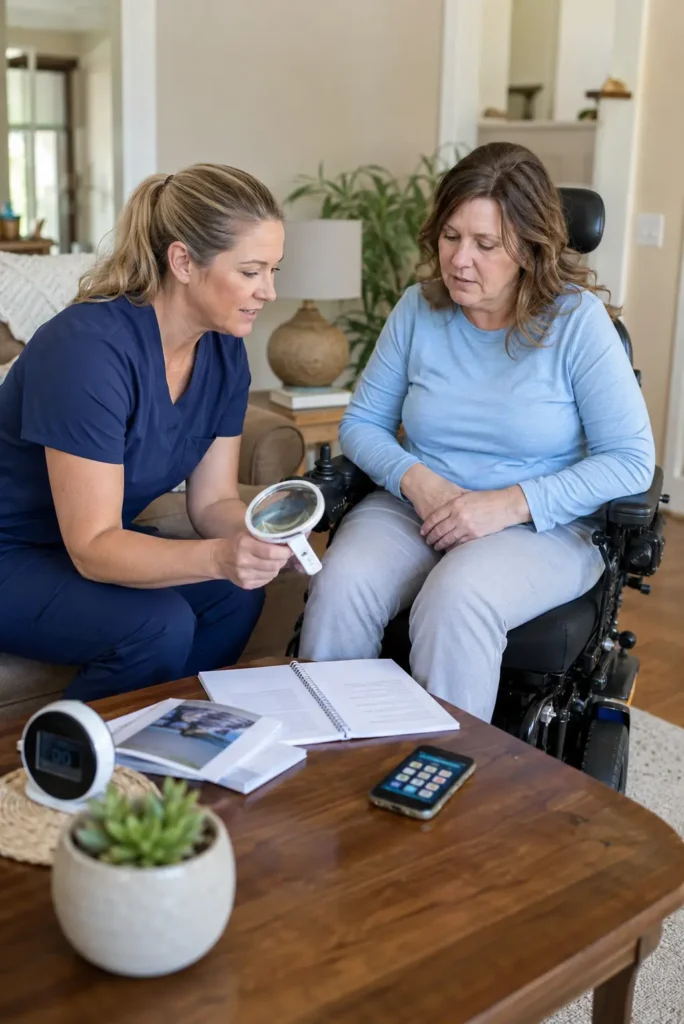
Adaptive Equipment Recommendations (Occupational Therapy)
OTs recommend and train patients on:
- Magnification devices for reading
- Talking watches and clocks
- Voice-activated technology
- Large-print materials
- Smartphone accessibility features
- Identification systems for medications, money, and important documents
Coordination With Vision Specialists (Medical Social Work)
Our medical social worker coordinates referrals to:
- Neuro-ophthalmology for ongoing MS-related vision monitoring
- Low-vision rehabilitation specialists
- State vocational rehabilitation services
- Florida Division of Blind Services for eligible patients
- MSAA equipment grants for vision-related assistive technology
Home Safety Evaluation (Occupational Therapy)
OTs conduct comprehensive home safety evaluations specifically with vision impairment in mind:
- Lighting modifications – increased illumination, reduced glare, even light distribution
- Contrast strategies – high-contrast tape on edges of stairs, kitchen counters, switches
- Removing trip hazards – throw rugs, loose cords, low furniture
- Furniture arrangement – consistent placement so the patient can navigate by memory
- Bathroom modifications – grab bars positioned for visual access
- Kitchen organization – tactile labels, consistent storage
Fall Prevention (Physical Therapy)
PTs adjust gait training, balance work, and walking strategies for vision-impaired MS patients. Vision is one of three sensory inputs the brain uses for balance (along with vestibular and proprioceptive systems), and when vision is impaired, the other two need to compensate. Targeted exercises strengthen this compensation.
Many MS patients with vision changes continue to drive long after they probably should not, partly because they do not recognize the extent of their impairment and partly because driving represents independence they are not ready to give up. This is one of the hardest conversations in MS care.
Our team does not make driving decisions – those belong to the patient, the family, the neurologist, and sometimes the state. But we observe driving capacity during care visits, surface concerns when they arise, and help families navigate transportation alternatives when driving becomes unsafe. MS Focus Foundation Transportation Program (Lyft-based rides to medical appointments) is often the bridge that allows patients to stop driving without isolating themselves.
Heat and MS Vision (Uhthoff Phenomenon)
Heat triggers temporary worsening of MS symptoms, and optic neuritis residuals are especially heat-sensitive. Many MS patients notice their vision blurs in hot weather, during exercise, or in a hot shower. This is normal Uhthoff phenomenon – temporary, reversible, but a real safety issue. Our care plans build this into activity planning for South Florida patients.
Eligibility and Cost
Home safety evaluation, PT, OT, adaptive equipment training, and care coordination for vision-impaired MS patients are delivered as part of standard Medicare home health coverage at $0 copay for eligible patients.