Types of Multiple Sclerosis: A Plain-English Guide for Patients and Families
Multiple sclerosis is not one disease. It is a family of related disease courses, each with a different pattern of progression, a different prognosis, and a different set of care needs. Understanding which type of MS you or your loved one has is the foundation for every treatment decision that follows — including the kind of skilled home health care that will help most.
This page walks through all four recognized types of MS, what to expect from each, and how home health care fits in. It is written for patients and families — not for neurologists. If you’ve just been diagnosed, or if your MS is changing, this is the overview most people don’t get from a 15-minute appointment.
The 4 Types of Multiple Sclerosis (Per the National MS Society)
In 1996 the National MS Society defined the original four MS courses, and in 2013 they refined the classification we still use today. Every MS patient fits into one of these patterns:
- Clinically Isolated Syndrome (CIS)
- Relapsing-Remitting MS (RRMS)
- Secondary Progressive MS (SPMS)
- Primary Progressive MS (PPMS)
A fifth designation — Progressive-Relapsing MS (PRMS) — was used historically and is now folded into the SPMS and PPMS categories as “active” disease.
How to Start Services
Care begins with a referral from your physician — typically your neurologist or primary care doctor. From the moment we receive a complete referral, an RN can be at your home within 24 to 48 hours for the initial OASIS assessment. Skilled visits typically begin within 5 days of the first call.
Better outcomes at home.
Clinically Isolated Syndrome is a single first episode of neurological symptoms — vision changes, weakness, numbness, or balance problems — caused by inflammation or demyelination in the central nervous system, lasting at least 24 hours. CIS is not always MS. But when MRI scans reveal lesions consistent with MS, 60 to 80 percent of CIS patients will be diagnosed with MS within a few years. Without those lesions, the conversion rate drops to about 20 percent.
People with CIS rarely need home health care unless the initial episode caused significant disability. The bigger role for our team at this stage is education — helping families understand what MS may bring and how to plan ahead.
Relapsing-Remitting MS is by far the most common form — about 85 percent of MS patients are diagnosed with RRMS first. RRMS is defined by clearly defined relapses (also called flares or exacerbations) — episodes of new or worsening neurological symptoms lasting at least 24 hours — followed by partial or complete remissions. Between relapses, the disease appears stable, though underlying damage may continue silently.
RRMS typically presents in the 20s and 30s, affects women three times more often than men, and is the form most likely to respond to disease-modifying therapies (DMTs). Home health care during the RRMS phase often centers on relapse recovery — IV steroid administration coordination, physical and occupational therapy after a flare to recover function, and skilled nursing for new symptom management. Most RRMS patients live near-normal lives between relapses with the right medical team supporting them.
A lifetime of better health.
Better outcomes at home.
Secondary Progressive MS develops out of RRMS as accumulated nerve damage begins to outpace the body’s ability to recover. Without disease-modifying therapy, roughly half of RRMS patients transition to SPMS within 10 to 15 years. Modern DMTs appear to delay this transition, though the magnitude of the delay is still being studied.
In SPMS, disability worsens steadily over time — and importantly, this progression is now understood to happen independently of relapses. A 2024 Italian registry study found that SPMS patients with active relapses and those without showed similar long-term disability progression. The takeaway: by the time SPMS is established, what drives disability is the slow underlying neurodegeneration, not the visible flares.
Home health care plays a much larger role in SPMS. Patients in this phase often experience increasing fatigue, mobility decline, bladder and bowel dysfunction, spasticity, and the cognitive symptoms that characterize the progressive phase. Skilled nursing for catheter management, physical and occupational therapy for maintenance and adaptation, and home health aide support for daily activities become foundational.
Primary Progressive MS affects 10 to 15 percent of people with MS. Unlike RRMS, PPMS is characterized by steady worsening of neurological function from the very first symptom — without distinct relapses and without remissions. PPMS typically presents about a decade later than RRMS, with an average age of onset around 40, and affects men and women in roughly equal numbers (some studies show a slight male predominance).
PPMS tends to affect the spinal cord more than the brain, so mobility decline often dominates. The median time from PPMS onset to needing a walking aid is approximately 7 years in untreated patients, though this varies widely. Cognitive symptoms also appear, and fatigue and bladder dysfunction are nearly universal.
Home health care is often introduced earlier in PPMS than in RRMS because the disability arrives without the remission periods that allow recovery. Physical therapy for gait and balance, occupational therapy for ADLs, and skilled nursing for medication and bladder management are typical first services. Maintenance therapy — protected by the Jimmo Settlement — is especially important here, because Medicare cannot deny coverage simply because a PPMS patient is not expected to improve.
A lifetime of better health.
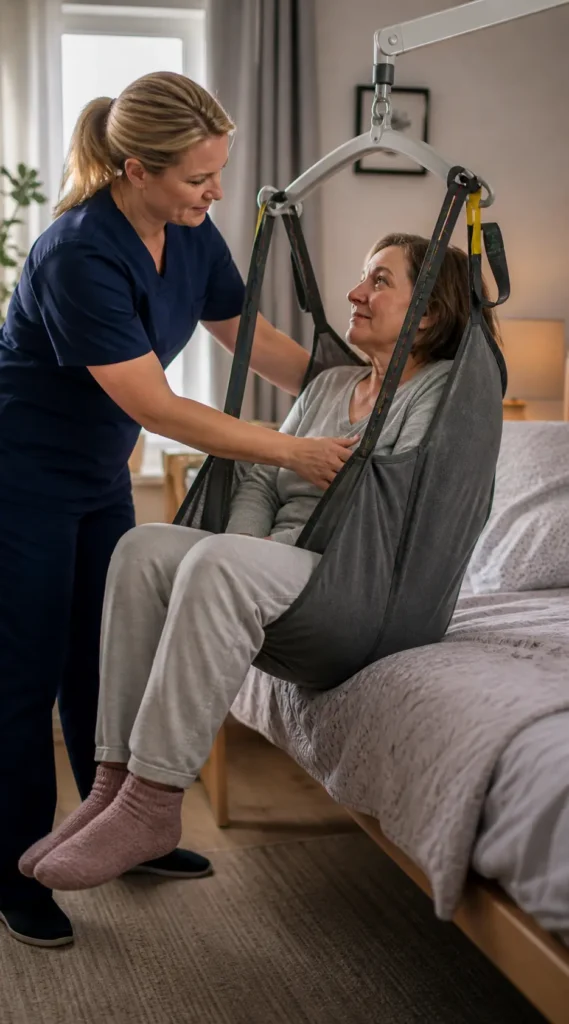
Advanced MS is where home health becomes essential. Skilled nursing for catheter and bowel management. Pressure injury prevention for non-ambulatory patients. Spasticity management. Dysphagia screening. Medication oversight. Caregiver respite through aide visits. This is the population most underserved by traditional outpatient care — and the population our program was specifically built to support.
MS/ Founder
Advanced and Progressive MS: What This Means for Care
“Advanced MS” is not technically a fifth type — it’s a clinical descriptor for any MS patient (RRMS, SPMS, or PPMS) whose disability has progressed to require significant assistance. Clinicians often define it by the EDSS (Expanded Disability Status Scale) score: roughly EDSS 6.0 and higher, meaning the patient needs intermittent or constant help to walk, uses a wheelchair, or is bedbound.

MS Life Expectancy and Long-Term Outlook
Most people with MS live a near-normal lifespan — typically 5 to 10 years shorter than the general population, with the gap closing as treatment improves. What MS most often takes is not years of life, but years of full function. The goal of care, including home health, is to preserve function for as long as possible: independence, mobility, communication, dignity, quality of life.
How to Tell Which Type of MS You Have
Only your neurologist can diagnose your specific type of MS, based on your clinical history, MRI findings, and how the disease has behaved over time. If you’re unsure of your MS type, ask at your next neurology appointment — and ask whether your designation has changed (transitions from RRMS to SPMS often happen quietly). For our team, knowing your specific MS type helps us build a care plan that fits the disease pattern, not a generic template.
How Home Health Care Adapts to Each MS Type
- CIS — Education, fall prevention, family planning. Care typically intermittent or not yet needed.
- RRMS — Relapse recovery, IV steroid coordination, post-flare PT/OT, skilled nursing for symptom management.
- SPMS — Ongoing skilled nursing, maintenance PT/OT, bladder and bowel management, increasing aide support, fatigue/cognition strategies.
- PPMS — Early home health introduction, mobility-focused PT, ADL-focused OT, skilled nursing for medication oversight, maintenance therapy under Jimmo.