MS Home Health Services: The Full Range of Skilled Care Medicare Covers
Living with multiple sclerosis often means juggling more specialists, more medications, and more daily challenges than any one person should have to coordinate alone. The good news is that Medicare-covered home health care brings most of the help you need into your own home — under one care plan, working with your neurologist, with no copay for eligible patients. This page lays out every service we provide, what each clinician actually does for MS patients, and how all of it fits together into a single skilled home health plan of care.
MS Home Health Care, powered by Focus Family Care, delivers the full range of Medicare-certified home health services across all seven South Florida counties — Miami-Dade, Broward, Palm Beach, St. Lucie, Martin, Indian River, and Okeechobee. Every service below is staffed by a licensed clinician who is a direct W-2 employee, not a contractor or registry hire.
Information Gain: How These Services Work Together for MS
Most home health agencies treat the six services above as a list. We treat them as a system. Here’s how the team integrates around an MS patient:
- The skilled nurse is the clinical coordinator — managing medications, monitoring for complications, communicating back to your neurologist after every visit
- The physical therapist works on what's fixable — mobility, balance, strength, fall risk — and what's preventable, like contractures from spasticity
- The occupational therapist focuses on independence in daily life — adaptive equipment, cognitive strategies, energy conservation, heat protocols
- The speech-language pathologist is brought in when swallowing or speech changes appear — early intervention prevents aspiration and preserves communication
- The home health aide handles the personal care that exhausts family caregivers — typically 1 to 3 visits per week, scheduled around skilled visits
- The medical social worker fills the gaps — assistance programs, family counseling, hospital coordination, advance care planning
How to Start Services
Care begins with a referral from your physician — typically your neurologist or primary care doctor. From the moment we receive a complete referral, an RN can be at your home within 24 to 48 hours for the initial OASIS assessment. Skilled visits typically begin within 5 days of the first call.
Every clinician documents to your physician after every visit. Every change in your condition triggers a care plan update. You and your family always know what’s happening.
Our Services




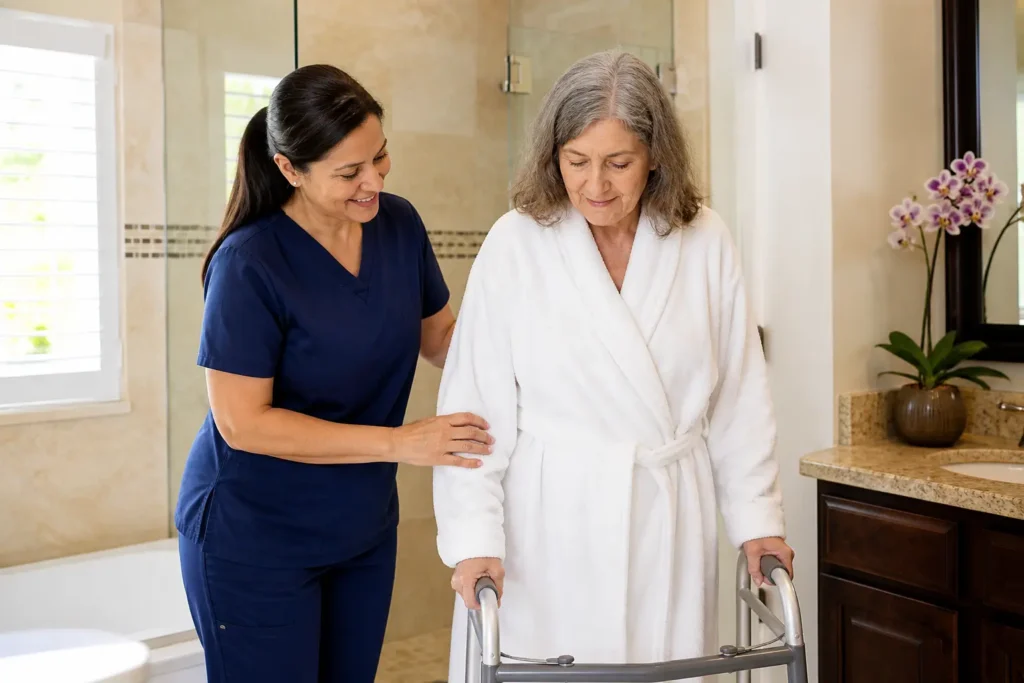

Better outcomes at home.
Visit frequency is set by your plan of care — the document your doctor signs that lists each service, how often, and for how long. Typical patterns for MS patients on Medicare home health look like this:
- Skilled nursing: 1 to 3 visits per week initially, often reducing to weekly or biweekly as the patient stabilizes
- Physical therapy: 2 to 3 visits per week during active rehabilitation, often reducing for maintenance therapy under the Jimmo Settlement
- Occupational therapy: 1 to 2 visits per week, often paired with PT visits for efficiency
- Speech-language pathology: 1 to 2 visits per week, typically time-limited to specific goals
- Home health aide: 2 to 3 visits per week for personal care, scheduled around skilled visits
- Medical social worker: 1 to 2 visits per episode, often by phone after the initial in-home assessment
Across all services combined, Medicare allows up to 28 hours per week (occasionally up to 35 in short-term exceptional cases) on an intermittent basis.
What Medicare Doesn't Cover Through Home Health
Honesty matters in healthcare more than anywhere. Medicare home health is a powerful benefit, but it has limits we are upfront about:
When patients need more than Medicare covers, our medical social worker helps families combine Medicare with Florida Medicaid HCBS waivers, MS Focus Foundation Homecare Assistance Grants, long-term care insurance, VA Aid & Attendance benefits, or private-pay services. A complete care plan often draws from several funding sources.
- 24-hour care at home
- Long-term homemaker services (cleaning, shopping, laundry) when this is the only need
- Personal care alone, without an accompanying skilled service
- Meals delivered to the home
- Long-term nursing facility placemen