MS Caregivers and Families: You Do Not Have to Do This Alone
If you are caring for someone you love who has multiple sclerosis, you already know how much MS caregiver home health support matters in daily life. You may be doing things you never imagined doing — managing medications, helping with bathing, watching for falls, learning catheter care, juggling appointments, and trying to hold the rest of your life together at the same time. You are not alone, and you are not failing.
The Stages of Caregiver Burnout — and Why You Need MS Caregiver Home Health Support
Researchers studying MS caregivers have identified a predictable burnout arc:
- Phase 1 — The honeymoon: optimism, strong desire to help, energy to spare. After 16 to 18 months, routine sets in and unexpected disappointments accumulate.
- Phase 2 — Decreasing motivation: putting in more time but with less energy and poorer results. Complaints increase. The caregiver begins withdrawing socially.
- Phase 3 — Chronic depression and resentment: physical symptoms appear. Anger surfaces. The caregiver may neglect their own health, miss their own medical appointments, and feel trapped.
- Phase 4 — Crisis: caregiver illness, breakdown of the relationship, or sudden inability to continue caring. This is the phase that often triggers nursing home placement — not because the patient needs facility-level care, but because the caregiver has nothing left.
The earlier professional home health enters the picture, the less of this arc you have to live through.
The Numbers Behind What You're Doing
Roughly 80% of MS care in the United States is provided by unpaid family caregivers. The average MS caregiver provides about 6.5 hours of care per day — the equivalent of a near-full-time job. Caregivers of advanced MS patients often provide significantly more, sometimes attending to needs around the clock. Caregiver burden in MS is comparable in magnitude to caregiver burden in Alzheimer’s disease.
None of this is meant to make you feel worse. It’s meant to make clear: what you are doing is enormous, it is recognized clinically, and the toll it takes on you is well-documented and predictable. Caregiver burnout is not a character flaw. It is a foreseeable consequence of trying to do too much for too long without help.
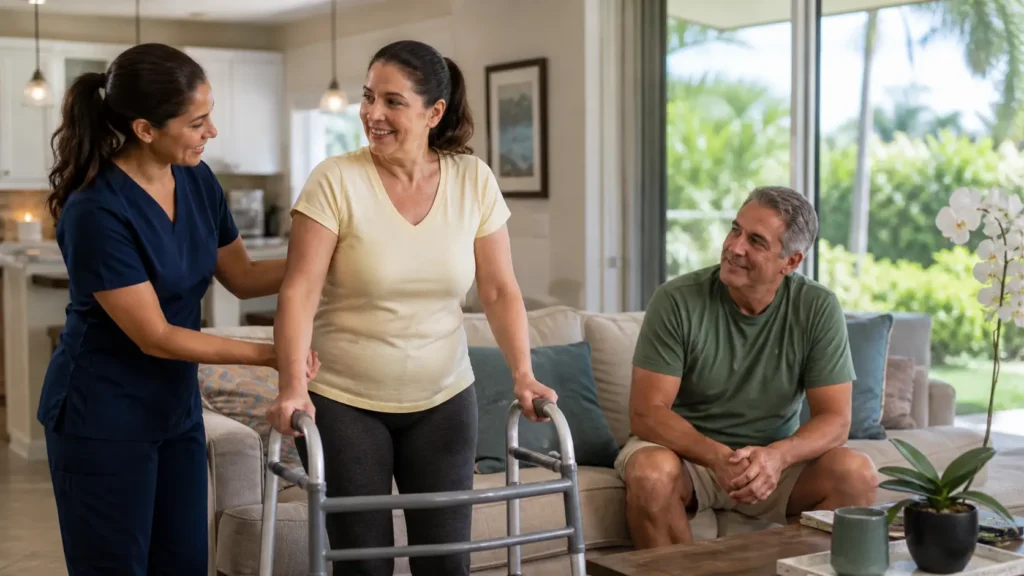
Medicare-covered home health is more than respite — it is direct clinical relief. Here’s what the team takes off your plate:
- A registered nurse manages medications, catheter care, wound care, injection teaching, and ongoing assessment — meaning you stop being the person responsible for catching every clinical issue
- A physical therapist handles gait, balance, fall prevention, and exercise programming — meaning you stop being the one to figure out how to keep them moving safely
- An occupational therapist works on bathing, dressing, kitchen safety, and cognitive strategies — meaning you stop having to invent solutions for daily activities
- A home health aide provides hands-on personal care two to three times per week — meaning you can take a shower, run errands, or just sit down without guilt
- A speech therapist addresses swallowing and speech changes — meaning you don’t have to wonder whether your loved one is at aspiration risk
- A medical social worker handles paperwork, insurance, grants, and emotional support — meaning you stop drowning in the system
Each of these is covered by Medicare at $0 copay when your loved one meets eligibility. None of it requires you to give up your role. You remain the spouse, the daughter, the son, the partner. The clinicians become your team.
The patient’s spouse becomes a spouse again, not a part-time nurse. The adult child gets to be present without measuring out medication. Conversations have room for things other than care logistics. That matters for the patient, and it matters for you.

MS/ Founder
"But Won't Bringing in Help Make Them Feel Worse?"
This is the worry we hear most often, and the research suggests the opposite: MS patients with appropriate professional support generally do better, both clinically and emotionally, than those whose families try to manage everything alone. The reason isn’t complicated — when professionals handle medical tasks well, family relationships go back to being family relationships.
Information Gain: What South Florida MS Caregivers Specifically Need to Know
Caring for an MS patient in South Florida adds two challenges most caregiver guides don’t address:
Heat management is daily, not seasonal
Uhthoff’s phenomenon — the worsening of MS symptoms with heat — is a year-round reality here. As a caregiver, you may already have noticed your loved one declines after time outside, in a hot car, or in a warm room. Our occupational therapists train caregivers on heat-management strategies: cooling vest use, scheduling activities, hydration tracking, and what to do when symptoms worsen suddenly during heat exposure. This kind of practical training reduces both the patient’s symptom burden and your stress.
Hurricane preparedness is real for MS households
MS patients dependent on power for mobility devices, BiPAP, refrigerated medications, or hospital beds need a real disaster plan. Our team helps families build it: medication stockpiles, backup power coordination, county special-needs registry enrollment, evacuation contingencies, and shelter information. You should not be figuring this out on your own.
There is no version of caregiving that works long-term if you neglect yourself. Caregivers who don’t get help eventually become unable to provide it. So the most caring thing you can do for your loved one is take steps to remain well — sleep, eat regularly, see your own doctor, maintain at least one social connection, and accept respite when it’s available.
- Use the time professional visits create to do nothing — really nothing — at least once a week
- Talk to someone outside the situation. A friend who isn’t involved, a therapist, or a caregiver support group
- Don’t compete over who has it worse. The patient and the caregiver are both struggling, in different ways
- Reach out for professional mental health support when you need it. The National MS Society (800-344-4867) and MS Focus (888-673-6287) can help connect you
If you’re ready to start, you can:
- Call us at (561) 693-1311 — we walk you through Medicare verification, physician coordination, and intake
- Talk to your loved one’s neurologist about a home health referral
- Download our free Medicare guide to share with the family before you decide
MS Focus Foundation: A Local Resource Most Families Don't Know About
MS Focus — the Multiple Sclerosis Foundation — is headquartered right here in Fort Lauderdale, and they offer programs that meaningfully complement Medicare home health. Their Homecare Assistance Grant funds short-term home care services for qualifying low-income MS patients. Their Cooling Program provides cooling vests at no cost. They run Lyft-based transportation programs to neurology appointments. Their helpline (888-673-6287) is bilingual English-Spanish. We help our caregivers connect with all of it.