MS Symptoms That Home Health Care Can Help You Manage
Multiple sclerosis presents differently in every patient — but the symptoms it produces fall into a handful of well-known categories, most of which are examples of MS symptoms home health can help manage through skilled, personalized care. This page walks through the MS symptoms our team manages most often, what each symptom actually feels like for the patient and family, and exactly what a home nurse, physical therapist, occupational therapist, or speech-language pathologist can do about it in your home.
MS Fatigue ("Lassitude") — The Symptom That Affects Almost Everyone
Fatigue is the most common MS symptom, reported by roughly 80% of patients and rated as the most disabling symptom by 40% of them. MS fatigue is not ordinary tiredness. It is a sudden, overwhelming exhaustion that descends with little warning, persists despite sleep, and worsens with heat, exertion, or stress. Patients describe it as the difference between being tired and being unable to function.
Home health helps in several ways. Occupational therapists teach evidence-based energy conservation techniques — pacing, prioritization, and environmental modification — that have been clinically shown to reduce fatigue impact. Physical therapists prescribe carefully graded exercise programs that improve cardiovascular fitness without triggering symptom worsening (because deconditioning makes MS fatigue dramatically worse). Skilled nurses screen for treatable contributors that often hide behind MS fatigue: sleep apnea, depression, anemia, vitamin D deficiency, and medication side effects.
How to Start Services
Care begins with a referral from your physician — typically your neurologist or primary care doctor. From the moment we receive a complete referral, an RN can be at your home within 24 to 48 hours for the initial OASIS assessment. Skilled visits typically begin within 5 days of the first call.
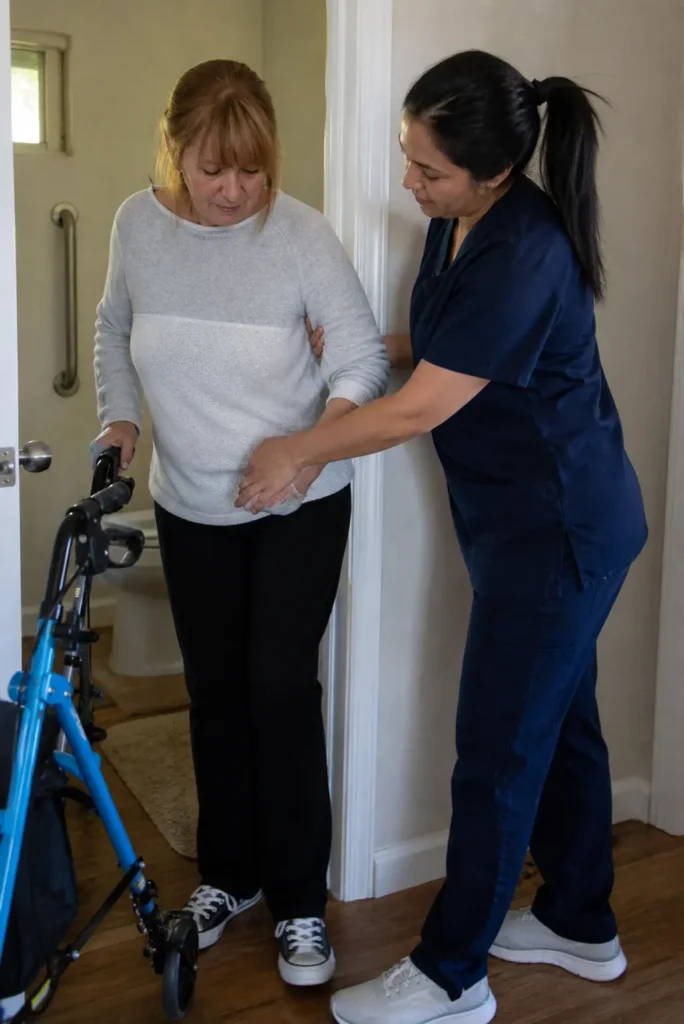
Mobility loss is one of the most visible signs of MS progression. It can stem from weakness, spasticity, ataxia, sensory loss, or fatigue — often several at once. Falls are a constant risk: MS patients fall roughly three times more often than the general population, and falls are a major reason patients end up in hospital settings.
MS/ Founder
Walking and Mobility Difficulties
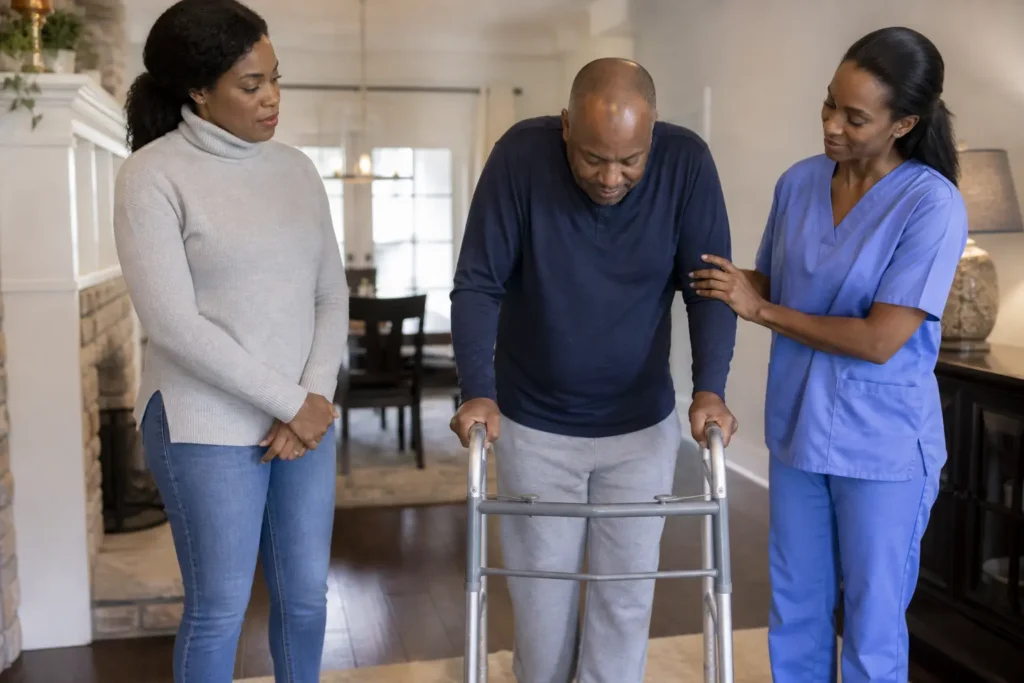
Physical therapists provide gait training with assistive devices (cane, walker, AFO bracing), balance therapy, and strengthening for unaffected muscle groups. They conduct home safety evaluations and recommend modifications — grab bars, ramps, raised toilet seats, shower benches — that reduce fall risk where you actually live. Occupational therapists help with transfer training (bed-to-chair, chair-to-toilet, car transfers), which is where most falls actually happen. The combination of PT and OT in the home is one of the most effective interventions in all of MS care.
Better outcomes at home.
Up to 80% of MS patients experience bladder dysfunction, and roughly half experience bowel dysfunction. These symptoms are deeply private and often go undiscussed even with neurologists — but they are critical, because bladder dysfunction is the leading cause of MS hospitalization through urinary tract infections, urosepsis, and kidney damage.
Skilled nursing visits for MS bladder management can include intermittent self-catheterization training, indwelling catheter changes, suprapubic catheter management, bladder scan monitoring, and UTI prevention protocols. Bowel programs developed by skilled nurses — combining diet, hydration, scheduled toileting, medications, and digital stimulation when needed — prevent the impactions and obstructions that send so many MS patients to the emergency room.

Spasticity and Muscle Spasms
Spasticity affects up to 80% of advanced MS patients. It can range from mild stiffness to painful, uncontrollable muscle contractions that disrupt sleep and movement. Untreated spasticity leads to contractures — permanent shortening of muscles and tendons — that may require surgical intervention.
Physical therapists provide stretching programs, positioning techniques, splinting, and education on how to time exercises to medication peaks. Skilled nurses monitor oral antispasticity medications (baclofen, tizanidine, dantrolene) for side effects and effectiveness, and coordinate with neurologists on intrathecal baclofen pump care for patients on advanced therapy. Maintenance therapy under the Jimmo Settlement specifically protects ongoing spasticity care, even when the patient is not expected to improve.
Cognitive Symptoms — "MS Brain Fog"
Roughly half of MS patients experience cognitive symptoms across the disease course — most commonly slowed processing speed, executive dysfunction, attention difficulties, and short-term memory changes. Cognitive symptoms in MS are not dementia. They are a different pattern, often subtle, and often underrecognized.
Occupational therapists provide cognitive rehabilitation — strategies, environmental cues, and assistive technology that help patients compensate for processing changes. Skilled nurses coordinate with physicians on medication adjustments and screen for treatable contributors like sleep disorders, depression, and medication side effects (some MS-related medications themselves can blunt cognition). Family education is critical, because cognitive symptoms are often what family members find most distressing.
Pain and Sensory Symptoms
Roughly half of MS patients live with chronic pain — neuropathic pain (often described as burning or electric), spasticity-related pain, musculoskeletal pain from compensatory movement patterns, and trigeminal neuralgia. Sensory symptoms include numbness, tingling, the “MS hug” (girdle-like tightness around the torso), and Lhermitte’s sign (electric sensation down the spine with neck flexion).
Skilled nurses provide medication management for neuropathic pain agents (gabapentin, pregabalin, duloxetine), monitor for side effects, and educate patients on how to track pain patterns. Physical therapists address musculoskeletal pain through positioning, stretching, and posture work. Occupational therapists modify activities to reduce pain triggers.
Dysphagia and Speech Changes
Up to 40% of advanced MS patients develop swallowing difficulty. This is more than an inconvenience — aspiration of food or liquid into the lungs is a leading cause of pneumonia and hospitalization in MS, and it is often silent (no coughing, no obvious choking).
Speech-language pathologists conduct in-home dysphagia evaluations, recommend safe-swallow strategies (chin-tuck, posture changes, dietary modification), and provide exercises to strengthen swallowing muscles. They also treat dysarthria — slurred or scanning speech — and cognitive-communication challenges. Early SLP intervention often prevents the kind of hospitalization that derails everything.
Vision Problems
Roughly 80% of MS patients experience an episode of optic neuritis at some point. Some recover full vision, some don't. Other vision issues include double vision (diplopia), nystagmus, and visual field defects. Severe vision impairment affects safety at home and increases fall risk. Occupational therapists conduct home safety evaluations specifically with vision impairment in mind — lighting modifications, contrast strategies, removing trip hazards. Physical therapists adjust gait training and balance work for vision changes. Skilled nurses coordinate with ophthalmology and neurology on vision-affecting medications.
Depression and Anxiety
Lifetime depression prevalence in MS exceeds 50%. Anxiety is similarly common. Suicide risk is elevated in MS compared to the general population. These are not character flaws — they are symptoms of the disease, driven by both neurological changes and the chronic stress of living with a progressive condition. Medical social workers screen for depression and anxiety, link patients to mental health resources, and provide short-term counseling. Skilled nurses monitor for medication interactions and side effects in patients on antidepressants. Family education helps loved ones recognize the difference between situational sadness and clinical depression that needs intervention.
This is the symptom most home health programs designed for cold climates simply don’t address. About 60 to 80% of MS patients experience worsening of neurological symptoms with even small increases in core body temperature — a phenomenon described by ophthalmologist Wilhelm Uhthoff in 1890 and now well-documented in neurology literature. A hot shower, a sunny afternoon walk, exercise, or fever can transiently worsen weakness, vision, fatigue, or cognitive symptoms within minutes.
In South Florida, this matters every day. Our care plans build heat management into daily life: cooling vest education and use, scheduling exercises during the cooler parts of the day, hydration tracking, hot-weather contingency planning, durable medical equipment recommendations for cooling devices, and education for family members on what to do when symptoms worsen suddenly during heat exposure. Heat strategy isn’t an afterthought in our program — it’s a core clinical priority.
A lifetime of better health.
Better outcomes at home.
For MS patients with limited mobility, skin breakdown and pressure injuries are a constant risk and a serious complication. Stage 3 and 4 pressure injuries can require surgical treatment, lead to bone infection, and dramatically reduce quality of life.
Skilled nurses assess skin integrity at every visit, develop turning and positioning schedules, recommend pressure-relief surfaces, and provide wound care for any skin breakdown that develops. Prevention is far easier than treatment — and home health is uniquely positioned to deliver prevention because we see patients in the environment where the risk lives
How These Symptoms Connect to Your Plan of Care
When you start home health care, the registered nurse’s initial OASIS assessment screens for every symptom listed above. Your plan of care is then built around the specific symptoms you experience — which clinicians will visit, how often, what they will work on, and how progress will be measured. The plan adapts as your needs change. Maintenance therapy continues as long as skilled care is needed.