Occupational Therapy for MS at Home: Living Independently
Occupational therapy is one of the most distinctively MS-relevant home health services Medicare covers – and one of the most underused. While physical therapy addresses what your body can do, occupational therapy addresses what you actually do all day: bathing, dressing, cooking, working, parenting, and the hundreds of other activities that make up daily life. For MS patients, the symptoms most likely to affect daily life – fatigue, cognitive changes, fine motor difficulty, heat sensitivity – are exactly the symptoms OTs specialize in.
Home-based OT brings a licensed occupational therapist into your kitchen, your bathroom, and your bedroom – the actual environments where MS makes daily life harder. Medicare covers it at $0 copay for eligible patients.
What a Home OT Visit for MS Looks Like
A typical home occupational therapy visit lasts 45 to 60 minutes and includes some combination of:
- Activities of daily living (ADL) evaluation and training - bathing, dressing, grooming, toileting
- Adaptive equipment recommendations and training
- Home safety evaluation - particularly bathroom, kitchen, and bedroom
- Energy conservation training for MS fatigue
- Cognitive rehabilitation strategies
- Upper extremity strengthening and dexterity work
- Splinting for hand spasticity or weakness
- Heat management strategies - particularly important in South Florida
- Driving adaptation when relevant
- Caregiver training on safe assistance techniques
Maintenance OT Under Jimmo
The Jimmo Settlement specifically protects OT coverage for maintenance – preserving function, preventing decline, and maintaining independence in daily activities. This is critical for progressive MS patients.

MS-Specific OT Interventions : Occupational therapy for ms at home
Energy Conservation (The Packer Program)
The Packer fatigue management program is the gold standard evidence-based intervention for MS fatigue. Delivered by OTs in the home, it teaches the Four P framework: Prioritize, Plan, Pace, and Position. Clinical trials have shown meaningful fatigue reduction with this protocol.
Cognitive Rehabilitation
MS cognitive symptoms affect roughly half of patients. OTs teach compensatory strategies – external memory aids, environmental cues, routine establishment, single-tasking strategies, and family communication adaptations.
Driving Evaluation Coordination
OTs trained in driving rehabilitation assess driving safety and recommend adaptive equipment (hand controls, steering knobs) or, when appropriate, transition support to non-driving alternatives.
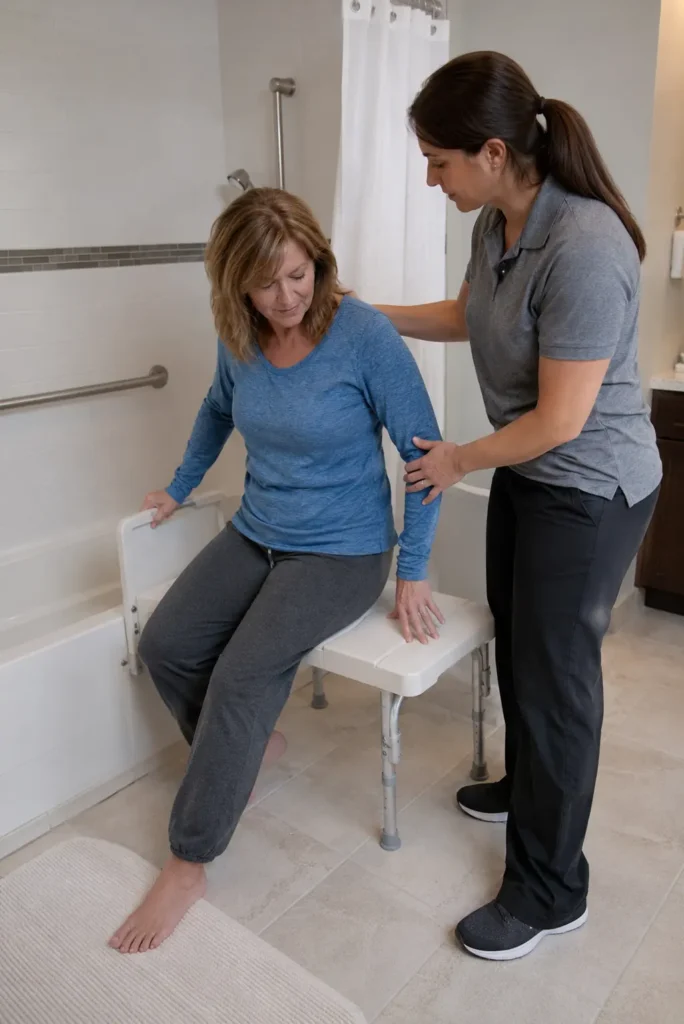
Adaptive Equipment for MS
OTs match equipment to specific patient symptoms. Common MS-relevant equipment includes:
- Tub transfer benches and shower chairs
- Raised toilet seats and toilet armrests
- Grab bars positioned for transfer support
- Long-handled bath brushes and shoe horns
- Sock aids and dressing sticks
- Built-up utensils and adaptive kitchen tools
- Reachers and grabbers
- Computer adaptations – voice recognition, ergonomic peripherals
- Cooling vests for Uhthoff phenomenon
Hand and Upper Extremity Therapy
MS affects fine motor function in many patients – handwriting, buttoning, using utensils, smartphone use. OTs provide hand strengthening exercises, coordination training, splinting for spasticity, and adaptive techniques.
Among the six Medicare-covered home health services, occupational therapy consistently has some of the highest patient satisfaction ratings in our MS population. The reason: OT changes daily life in ways patients can feel. A tub transfer bench means the patient can bathe again. A medication organizer means the spouse stops fighting about pill management. A cooling vest means the patient can spend time outside. These changes are tangible, immediate, and high-impact.
Physical therapy and skilled nursing matter enormously, but the work is often less immediately visible – preventing the UTI that did not happen, maintaining range of motion that does not decline. OT value is more visible because it solves the daily-life problems patients name first.
Eligibility and Cost
Medicare covers home OT at $0 copay for eligible patients. The 2025 Medicare home health OT per-visit rate is $190.08 nationally, with no patient copay under Original Medicare.