MS Fatigue Management at Home with Skilled Home Health Care
Fatigue is the most common multiple sclerosis symptom and rated by 40 to 60 percent of patients as the single most disabling thing they live with – more disabling than weakness, mobility loss, or pain. Roughly 80 percent of MS patients experience fatigue, and a 2024 systematic review and meta-analysis found global pooled prevalence of severe fatigue at 59 percent.
MS fatigue is not ordinary tiredness. It is a sudden, overwhelming exhaustion – sometimes called “lassitude” – that descends with little warning, persists despite sleep, and can cost an entire day of function. It is one of the most underestimated, undertreated symptoms in all of MS care. And it is also one of the most amenable to home health intervention, when the right team is involved.
What MS Fatigue Actually Feels Like: MS Fatigue Management at Home
Patients describe MS fatigue in specific ways that distinguish it from normal tiredness:
- It hits suddenly, often in the early afternoon, even after adequate sleep
- It makes simple tasks feel like climbing a mountain - opening a jar, holding a phone, following a conversation
- It worsens dramatically with heat, even mild heat (Uhthoff's phenomenon)
- It doesn't resolve with a nap the way ordinary tiredness does
- It has cognitive components as well as physical - "brain fog," word-finding difficulties, slowed thinking
- It often forces patients to ration their daily activity in ways that affect their entire life
Family members and even some clinicians often misread this as laziness or depression. It is neither. It is a documented neurological symptom of multiple sclerosis.
Our Promise
If you choose us, here’s what we promise: clinical care delivered by people who know MS. A care plan built around your specific symptoms, your specific home, and your specific family. Honest answers about what Medicare covers and what it doesn’t. And the kind of communication that means you never feel like you’re chasing us for an update.
If we ever fall short of that, tell us. We will fix it.

How Skilled Home Health Addresses MS Fatigue
From your first visit, we focus on making you feel welcome and at ease. Every session begins with a short consultation to understand your needs and ends with practical guidance for lasting results. Our goal is not just relief today, but long-term wellness.
Energy Conservation Training (Occupational Therapy)
The strongest evidence-based intervention for MS fatigue is the Packer fatigue management program – a six-week energy conservation course developed specifically for adults with chronic disease and tested extensively in MS populations. The program teaches the “Four P” framework: Prioritize (decide what matters), Plan (schedule activities around energy), Pace (build in rest), and Position (use the body efficiently).
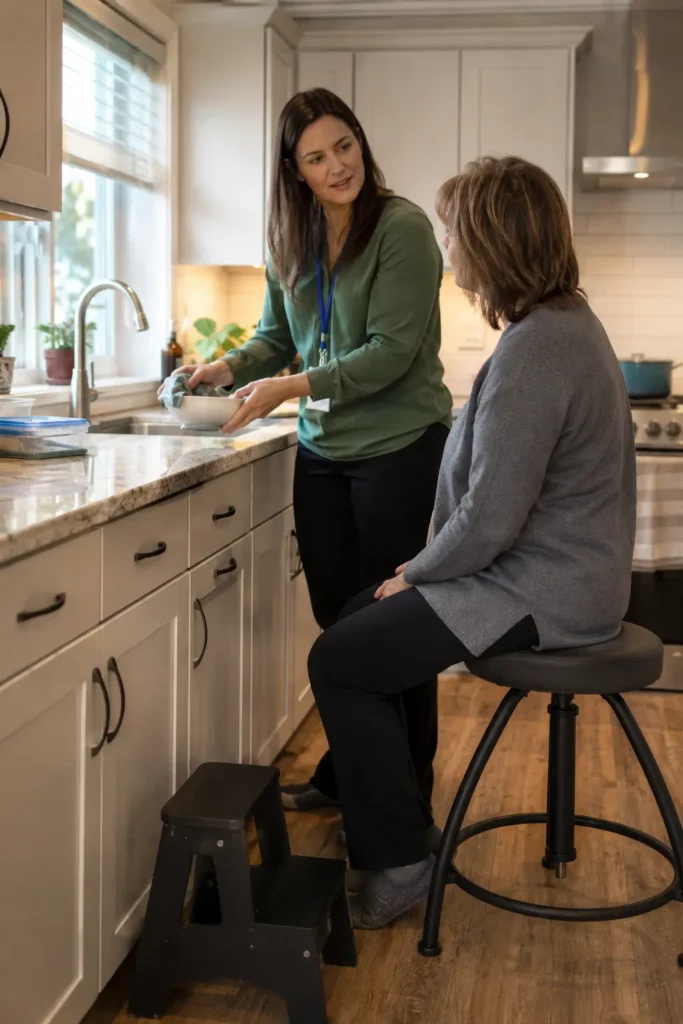
Occupational therapists deliver these strategies in the home, where they actually apply. Generic energy conservation tips don’t work as well as a strategy built around your specific kitchen, your specific bathroom, your specific morning routine.
Screening for Treatable Contributors (Skilled Nursing)
MS fatigue is sometimes the visible symptom of an underlying issue that’s actually fixable. Skilled nurses screen for:
- Sleep apnea (under-recognized in MS, treatable with CPAP)
- Depression and anxiety (highly treatable, often masked as fatigue)
- Anemia (a simple blood test catches it)
- Vitamin D deficiency (common in MS, easily corrected)
- Hypothyroidism
- Medication side effects (some MS medications themselves cause fatigue)
- Untreated bladder dysfunction disrupting sleep
- Poorly controlled spasticity disrupting sleep
When a treatable cause is identified, skilled nursing coordinates with the patient’s physician for evaluation and treatment.
Graded Exercise (Physical Therapy)
Counterintuitively, exercise reduces MS fatigue when properly prescribed. Deconditioning from inactivity dramatically worsens fatigue, while carefully graded aerobic and resistance exercise improves endurance, sleep, mood, and overall function. Physical therapists in the home design programs that account for heat sensitivity, fatigue patterns, and current function - pushing without triggering Uhthoff's phenomenon.
Heat Management (OT and PT)
In South Florida, heat is the primary external trigger for fatigue. Cooling vests, scheduled outdoor activity in cooler hours, indoor exercise during summer, hydration protocols, and air-conditioning planning are all standard parts of our care plans. We coordinate with MS Focus Foundation's Cooling Program for free cooling equipment when patients qualify.
Most MS fatigue management literature was written for cold-climate patients. South Florida MS patients face a year-round version of a problem that’s seasonal elsewhere: heat triggers fatigue, fatigue limits activity, limited activity drives deconditioning, deconditioning worsens fatigue. It’s a self-reinforcing loop, and it’s why generic fatigue advice often fails here.
Breaking the loop requires a coordinated approach: heat strategy from the OT, conditioning from the PT, sleep and mood evaluation from the nurse, and adaptive equipment from all three. This is exactly what skilled home health is designed to provide – and it’s why our patients often see meaningful fatigue improvement within the first few months of care, even when previous interventions failed.
Sleep Hygiene
MS-related sleep disruption is common and underaddressed. Common contributors include nocturia from neurogenic bladder, spasticity-related awakening, restless legs, and pain. Skilled home health addresses each: bladder management protocols, antispasticity medication timing, RLS evaluation referral, and pain management. Sleep hygiene education from the OT covers room temperature, light exposure, screen use, and routine.
MS/ Founder
Medications That Can Help
Pharmacological treatments for MS fatigue exist – amantadine, modafinil, and methylphenidate are commonly used off-label. Effectiveness varies, and side effects are real. Skilled nursing monitors response and side effects when these medications are part of the care plan, communicating with the prescribing physician about whether to continue, adjust, or change.

Better outcomes at home.
MS fatigue is invisible. Family members who don’t understand it can inadvertently make things worse – pushing the patient to do more, expressing frustration when plans change, interpreting fatigue as withdrawal. Our team educates families on what MS fatigue is, what to expect, and how to support without enabling. This education alone often improves household dynamics significantly.
Energy conservation training, screening for treatable causes, graded exercise, and heat management are all delivered as part of standard Medicare home health coverage at $0 copay for eligible MS patients. No separate authorization is needed.