Fall Prevention for MS Patients: A Home Health Approach
Fall prevention for MS patients is one of the highest-leverage interventions in home health care. MS patients fall approximately three times more often than the general population – and the consequences of falls in MS are often severe: fractures, head injuries, fear of further falls that limits mobility, hospitalizations that trigger functional decline, and the loss of independence that follows. Skilled home health fall prevention addresses all the contributing factors at once, in the actual environment where falls happen.
This page covers why MS patients are at elevated fall risk, what a comprehensive fall prevention program includes, what role each clinical service plays, and how families can support fall prevention between skilled visits.
Why MS Patients Fall So Often
Falls in MS are rarely caused by a single factor. They typically result from the convergence of multiple MS symptoms with environmental hazards. The major contributors:
Motor and Balance Symptoms
- Leg weakness (especially hip flexors and quadriceps)
- Spasticity that interferes with smooth walking
- Cerebellar ataxia and coordination problems
- Foot drop (inability to lift the front of the foot)
- Balance impairment from vestibular involvement
Sensory Symptoms
- Loss of proprioception (knowing where limbs are in space)
- Numbness or altered sensation in feet
- Visual problems (optic neuritis, double vision, nystagmus)
Cognitive and Fatigue Factors
- MS fatigue that worsens balance and judgment
- Cognitive symptoms that affect attention to walking
- Heat-induced symptom worsening (Uhthoff phenomenon)
Medication Effects
- Antispasticity medications causing weakness or sedation
- Anticholinergics causing cognitive dulling
- Sleep medications, pain medications, and antidepressants
Environmental Factors
- Throw rugs, loose cords, clutter
- Poor lighting, especially at night
- Uneven thresholds and stair risers
- Bathroom hazards (wet floors, low toilets, no grab bars)
- Pets underfoot
Better outcomes at home.
Most home health fall prevention programs are calibrated to general senior populations – frail older adults whose primary fall risks are weakness, vision loss, and medication interactions. MS fall prevention requires recognizing that MS-specific factors dominate.
MS-specific fall risks that generic programs miss:
- Heat-triggered symptom worsening (Uhthoff phenomenon) – a fall risk unique to MS that requires temperature management strategies
- Pseudo-relapse from UTIs presenting as acute mobility decline – looks like progressive MS but is treatable infection
- Fatigue patterns that vary by time of day – falls happen disproportionately in late afternoon/evening in MS patients
- Proprioceptive loss requiring specific compensation strategies (not just balance training)
- Spasticity-related sudden movements (clonus, flexor spasms) that cause falls during transfers
- Cognitive-motor interference – MS patients fall more often when doing two things at once
An MS-trained PT recognizes these patterns and builds fall prevention around them. A generic PT treats MS like generic senior weakness. The clinical outcomes diverge sharply over time.
Family caregivers play a critical role in fall prevention between PT and OT visits. Skilled nurses and therapists train caregivers in:
- Safe transfer techniques – bed to chair, chair to toilet, car transfers
- How to safely guard a patient during ambulation
- How to use a gait belt
- When to insist on assistive device use (even when the patient resists)
- How to recognize fatigue, heat exposure, or other contextual fall risks
- How to respond if a fall does happen
Better outcomes at home.
Components of a Comprehensive MS Fall Prevention Program
Skilled Nursing Medication Review Skilled nurses review medications for fall-contributing effects, communicate with the physician about high-risk medication combinations, and screen for orthostatic hypotension (a major fall trigger).
Physical Therapy Assessment and Training
A licensed physical therapist conducts a comprehensive falls assessment including:
- Gait analysis – identifying specific gait deviations
- Balance testing (Berg Balance Scale, Functional Reach Test, Timed Up and Go)
- Strength testing of key muscle groups
- Range of motion assessment
- Identification of which fall mechanisms dominate for this patient
Treatment then targets the specific deficits identified. PTs provide:
- Gait training specific to MS movement patterns
- Balance exercises tailored to your deficits
- Strengthening focused on hip flexors, quadriceps, and core
- Vestibular exercises when vestibular involvement is present
- Compensation strategies for proprioceptive loss
- Practice with assistive devices in your actual environment
Fall Recovery Plan
Even with prevention, falls sometimes happen. Skilled nurses help families create a fall recovery plan: when to call 911 versus the doctor, how to safely help someone up from the floor (or know when not to attempt it), how to manage minor injuries at home, and what to monitor in the days following a fall (head injury signs, hidden fracture pain).
Occupational Therapy Home Safety Evaluation
An OT conducts a comprehensive home safety evaluation including:
- Bathroom assessment (highest fall risk area) – grab bars, transfer benches, raised toilet seats
- Bedroom assessment – bed height, nighttime lighting, pathway to bathroom
- Kitchen assessment – reaching strategies, anti-slip flooring
- Stairs and thresholds – handrails, lighting, contrast strips
- Lighting throughout the home – especially nighttime navigation
- Removing trip hazards – rugs, cords, clutter
- Furniture placement for safe navigation
Assistive Device Fitting
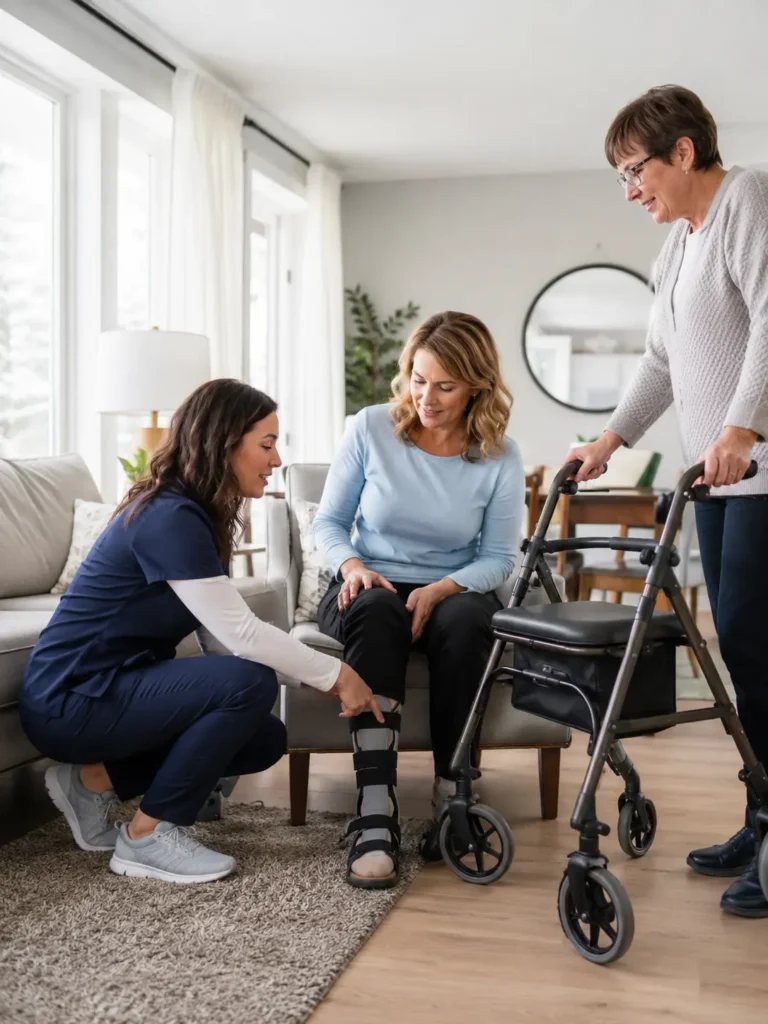
The right device matters as much as having one. PTs fit and train patients on:
- Single-point cane for mild balance support
- Quad cane for greater stability
- Rolling walker for moderate mobility limitation
- Four-wheeled walker (rollator) for longer distances
- Ankle-foot orthosis (AFO) for foot drop
- Functional electrical stimulation for select patients
Patients who self-select assistive devices often choose poorly – too much or too little support. PT fitting addresses this directly.
Eligibility and Cost
Fall prevention services delivered through physical therapy, occupational therapy, and skilled nursing are covered by Medicare at $0 copay for eligible patients. DME for fall prevention (grab bars, raised toilet seats, walkers, AFOs) is covered at 80% with 20% patient coinsurance after the Part B deductible.