MS Pain Management at Home: What Skilled Nursing Can Do
Pain is one of the most underrecognized symptoms of multiple sclerosis. For decades, MS was incorrectly described as a painless disease – a misconception that left patients undertreated and dismissed. The reality is that 50 to 80 percent of MS patients experience clinically significant pain at some point, and roughly half live with chronic pain. The pain takes many forms, requires different treatments depending on the type, and benefits substantially from skilled home health intervention.
Types of MS Pain
Neuropathic Pain
Neuropathic pain results from damage to the nervous system itself. MS neuropathic pain is often described as burning, electric, stabbing, or shooting. Common patterns include painful tonic spasms, dysesthetic extremity pain (often in the legs and feet), and Lhermitte sign (an electric sensation down the spine triggered by neck flexion).
Spasticity-Related Pain
Severe spasticity causes painful muscle cramping, particularly at night. Untreated spasticity progresses to contractures that themselves become a chronic pain source.
Musculoskeletal Pain
MS gait abnormalities, prolonged sitting, wheelchair use, and compensatory movement patterns create secondary musculoskeletal pain – low back pain, hip pain, shoulder pain in wheelchair users, and neck pain.
The MS Hug (Girdle Sensation)
A distinctive MS pain pattern: a band-like or girdle-like sensation of tightness around the torso, often described as a tight rubber band or a squeezing belt. Caused by spasms of the small muscles between ribs (intercostals), the MS hug can range from uncomfortable to severely painful.
Trigeminal Neuralgia
Severe facial pain caused by demyelination of the trigeminal nerve. MS patients are 20 times more likely to develop trigeminal neuralgia than the general population. Episodes are typically sharp, lancinating, and triggered by chewing, talking, or facial touch.
How Skilled Home Health Addresses MS Pain: MS Pain Management at Home
Heat and Cold Therapy Coordination
MS patients have to be careful with both heat and cold – heat triggers Uhthoff phenomenon (worsening neurological symptoms), and cold can exacerbate spasticity. Skilled home health coordinates temperature-based pain interventions safely.
Medication Management (Skilled Nursing)
First-line MS pain medications include gabapentin and pregabalin for neuropathic pain, baclofen and tizanidine for spasticity-related pain, duloxetine for chronic neuropathic pain with mood components, and carbamazepine for trigeminal neuralgia. Skilled nurses monitor for response, side effects, and drug interactions, communicating findings to the prescribing physician.
Non-Pharmacological Strategies (PT and OT)
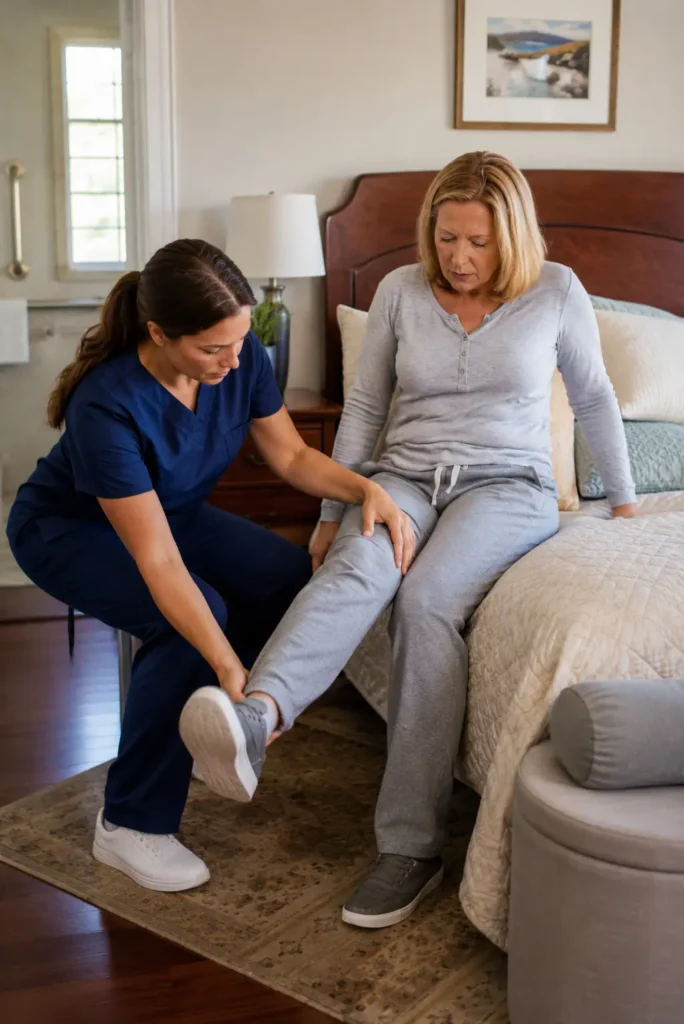
Physical therapists address musculoskeletal pain through posture work, stretching, and gait correction. They also implement stretching protocols and positioning for spasticity-related pain. Occupational therapists modify activities and equipment to reduce pain triggers – wheelchair seating, sleeping positions, transfer techniques.
Three reasons MS pain goes undertreated in many patients:
- Historical misconception – MS was long described as painless in textbooks, and that bias persists in some clinical practice
- Pain is invisible – unlike weakness or spasticity, pain is not visible to clinicians and depends entirely on patient self-report
- Pain medications interact with MS medications – opioids and benzodiazepines have problems in MS patients, and non-opioid options take more clinical effort to optimize
Home health is well-positioned to address all three. Continuous nursing assessment surfaces pain patterns that brief office visits miss. The skilled nurse relationship-based care creates trust for patients to report pain accurately. And the time available for medication titration and non-pharmacological strategies is far greater than in an office encounter.
Eligibility and Cost
Pain-focused skilled nursing, PT, and OT are delivered as part of standard Medicare home health coverage at $0 copay for eligible patients.