MS Walking Problems & Mobility: How Home Care Helps
MS walking problems home care becomes essential for many patients as walking and mobility difficulty is one of the most visible — and often most distressing — signs of multiple sclerosis. Approximately 75 percent of MS patients experience some degree of walking difficulty, and 40 to 50 percent will require an assistive device at some point. These changes do not happen suddenly. They accumulate slowly through weakness, spasticity, balance impairment, sensory loss, fatigue, and visual changes — often several at once.
Skilled home health, particularly physical therapy and occupational therapy, is one of the most effective interventions for MS mobility loss. Working in the actual home environment where falls happen, where transfers occur, and where daily activity takes place, our therapists adapt walking strategies to your specific spaces and your specific symptoms – and Medicare covers it at $0 copay for eligible patients.
Why Walking Becomes Difficult in MS
MS-related walking problems stem from multiple underlying causes, and effective treatment requires identifying which ones dominate for each patient:
- Weakness - particularly in the hip flexors, quadriceps, dorsiflexors (causing foot drop), and gluteals
- Spasticity - increased muscle tone causing stiffness and resistance to movement
- Ataxia - coordination problems caused by cerebellar lesions
- Sensory loss - loss of proprioception (knowing where your limbs are in space)
- Balance impairment - reduced ability to stay upright during walking
- Fatigue - particularly worsening throughout the day or with heat
- Visual problems - optic neuritis, double vision, or nystagmus affecting safe navigation
- Foot drop - inability to lift the front of the foot, causing tripping
Maintenance Therapy for MS Walking
Coverage for PT continues under the Jimmo Settlement even when improvement is not expected – for example, when the goal is maintaining current walking ability rather than restoring lost function. This is critical for progressive MS patients.

How Skilled Home Health Addresses Mobility Loss and MS Walking Problems Home Care
Gait Assessment and Training (Physical Therapy)
A licensed physical therapist evaluates your specific gait pattern, identifies which underlying mechanisms are most affected, and designs a training program targeted to those mechanisms. This goes far beyond walking practice – it includes step length training, weight shifting, cadence work, and adapting to surface changes.
Fall Prevention
MS patients fall roughly three times more often than the general population. PTs and OTs work in your home to identify specific fall hazards – uneven thresholds, loose rugs, poor lighting, problem stairs, bathroom risks – and recommend modifications. Balance training is structured around your specific deficits.
Assistive Device Fitting and Training
The right assistive device depends on your gait pattern, your strength, your balance, and the environments you navigate. PTs help select and train you on:
- Single-point cane – for mild balance support
- Quad cane – for greater stability
- Rolling walker – for moderate mobility limitation
- Four-wheeled walker (rollator) – for longer distances and seating breaks
- Ankle-foot orthosis (AFO) – for foot drop
- Knee-ankle-foot orthosis (KAFO) – for severe leg weakness
- Functional electrical stimulation (FES) – for select foot drop patients
- Manual or power wheelchair – for advanced mobility limitation
Transfer Training
Many MS-related falls happen during transfers – bed to chair, chair to toilet, car transfers. OTs and PTs train safe transfer techniques, recommend appropriate equipment (transfer benches, grab bars, hospital beds), and train family caregivers on safe assistance.
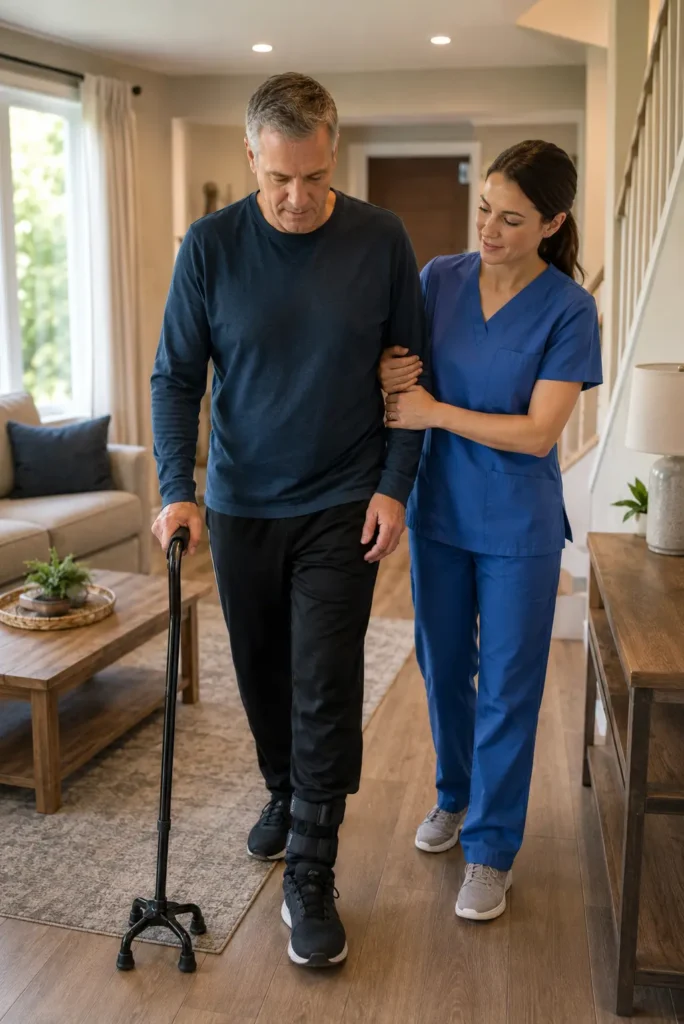
For most diagnoses, outpatient PT and home PT produce similar outcomes. For MS walking and mobility, in-home PT often produces better outcomes – and the reason is specific to the disease. MS gait varies widely based on fatigue, heat, time of day, and environment. The clean linoleum of an outpatient clinic does not simulate the throw rugs, narrow hallways, and uneven thresholds of an actual home. The 60-degree clinic temperature does not simulate the South Florida heat that triggers Uhthoff phenomenon at home.
In-home PT means training where you actually walk. Identifying hazards in the spaces where falls actually happen. Adapting to the heat conditions you actually live in. For MS patients with significant mobility limitation, this real-environment training is one of the few interventions specifically validated as superior in the home setting.
Eligibility and Cost
All mobility-focused PT and OT interventions described above are delivered as part of standard Medicare home health coverage at $0 copay for eligible patients.